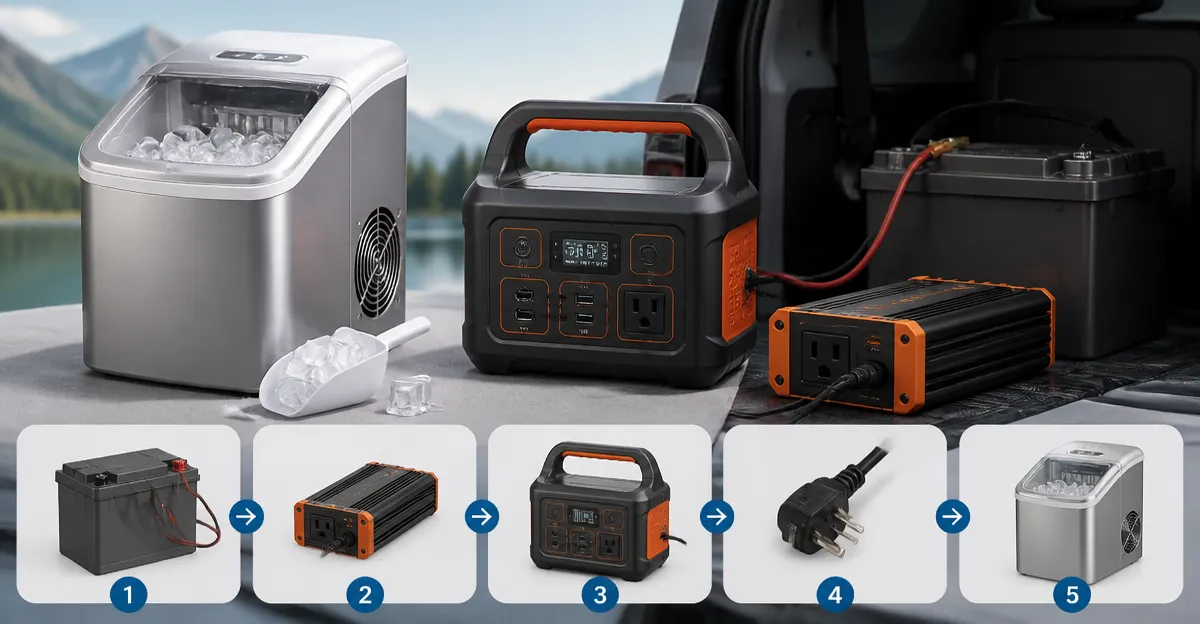
How to Run a Portable Ice Maker on a Battery Inverter: Sizing Guide for Jackery, NewAir & EUHOMY Power Stations
This guide explains how to operate a countertop ice maker using a portable battery inverter. One will learn how to calculate power draw, select an appropriate inverter, and connect the appliance safely. The information is valuable for outdoor events, camping trips, or emergency preparedness where grid power is unavailable. By following the steps, one can enjoy fresh ice anywhere without compromising safety or efficiency.
What You'll Need
- Portable battery power station (Jackery, NewAir, or EUHOMY model)
- Inverter rated for at least 150 W continuous output
- One of the recommended ice makers: Frigidaire Countertop Ice Maker, EUHOMY Smart Nugget Ice Maker, EUHOMY Countertop Ice Maker, or EUHOMY Portable Ice Maker
- Water source (bottled water or a clean tap)
- Extension cord rated for 120 V, 10 A
- Multimeter for voltage verification
- Optional: Surge protector for added safety
Step 1: Assess Power Requirements
The first step is to determine how much power the chosen ice maker consumes. The Frigidaire model lists a rated power of 105 W, while the EUHOMY Smart Nugget draws approximately 170 W during its peak cycle. The EUHOMY Countertop and Portable models also operate around 150 W. Knowing the wattage allows one to size the inverter and battery capacity accurately.
For example, running the Frigidaire Countertop Ice Maker for eight hours would require 105 W × 8 h = 840 Wh. If the battery station provides 1000 Wh usable capacity, the ice maker can operate continuously with a modest safety margin.
It is essential to consider the inverter's efficiency, typically 85‑90 %. Multiply the ice maker's wattage by 1.15 to account for conversion losses. This calculation ensures the battery will not be depleted prematurely.
Step 2: Choose a Compatible Inverter
Select an inverter that matches or exceeds the ice maker's peak power draw. A 150 W continuous inverter is sufficient for the Frigidaire and EUHOMY Countertop models, but the Smart Nugget may require a 200 W unit because of its 170 W compressor surge.
Jackery Explorer 500, NewAir Portable Power Hub 400, and EUHOMY Power Station 500 all include built‑in pure‑sine wave inverters rated above 200 W. Using a built‑in inverter simplifies wiring and reduces the need for external adapters.
When purchasing a separate inverter, verify that it supports 120 V AC output, the standard voltage for the listed ice makers. Additionally, ensure the inverter has overload protection to prevent damage if the ice maker draws more current than expected.
Step 3: Connect the Ice Maker to the Inverter
Begin by placing the battery station on a stable, level surface away from direct sunlight. Plug the inverter into the station's AC outlet, then use a 10‑A rated extension cord to connect the ice maker.
Before turning on the ice maker, use a multimeter to confirm that the inverter is delivering a steady 120 V. This step prevents voltage fluctuations that could shorten the appliance's lifespan.
Now activate the ice maker. The Frigidaire Countertop Ice Maker features an LED indicator that shows when the water reservoir is low; the EUHOMY Smart Nugget displays status lights for “Ready” and “Ice Full.” These visual cues help one monitor operation without constant inspection.
Step 4: Manage Water Supply Efficiently
All four ice makers require a water reservoir that must be refilled periodically. The Frigidaire model holds a modest amount of water and alerts the user when the level is low. The EUHOMY Smart Nugget includes a 1.3 lb ice basket; its self‑cleaning cycle also refreshes the water chamber, reducing the need for manual cleaning.
For extended off‑grid use, carry a 2‑liter water jug and keep it within reach. Fill the ice maker's reservoir before each cycle to avoid interruptions. If the battery station is positioned outdoors, protect the water source from freezing by using insulated containers.
Remember that ice makers do not store ice; they produce it and then melt if left unattended. Transfer the ice to a cooler or freezer promptly to maintain its hardness, especially in warm environments.
Step 5: Monitor and Optimize Operation
While the ice maker runs, keep an eye on the battery’s state of charge. Most power stations display remaining capacity as a percentage; aim to stop operation when the charge falls below 20 % to preserve battery health.
If the ice maker has a “Ice Full” indicator, pause production and empty the basket to reduce the load on the inverter. This practice prevents the compressor from cycling continuously, which can increase power draw.
For users with the EUHOMY Smart Nugget, the companion app allows remote start/stop commands. One can schedule ice production during periods of higher battery charge, such as after solar recharging, to maximize efficiency.
Tips & Pro Tips
- Use a surge protector between the inverter and ice maker to guard against voltage spikes caused by compressor start‑up.
- Keep the inverter’s ventilation clear; overheating reduces efficiency and may trigger automatic shutdown.
- When possible, pre‑chill the water in a refrigerator; colder water shortens the freeze cycle and reduces overall power consumption.
- For long events, rotate between two ice makers to share the load and extend battery runtime.
- Store the battery station in a temperature‑controlled environment; extreme cold can diminish available capacity.
Troubleshooting
No Ice Production: Verify that the water reservoir is filled and that the “Add Water” indicator is not flashing. Check that the inverter is delivering 120 V.
Ice Maker Shuts Off Unexpectedly: This often indicates low battery voltage. Reduce the load by turning off non‑essential devices or pause ice production until the battery recharges.
Excessive Noise: All models operate below 45 dB, but a noisy inverter can amplify sound. Ensure the inverter is placed on a vibration‑absorbing mat.
Conclusion
By calculating power needs, selecting a suitable inverter, and following safe connection procedures, one can reliably run a portable ice maker from a battery power station. The guide demonstrates how the Frigidaire Countertop Ice Maker, EUHOMY Smart Nugget Ice Maker, EUHOMY Countertop Ice Maker, and EUHOMY Portable Ice Maker each integrate into a mobile power setup. With careful monitoring, users can enjoy fresh ice at outdoor gatherings, camping trips, or during power outages.
Frequently Asked Questions
What size inverter is needed to run a portable countertop ice maker?
Choose an inverter with at least 150 W continuous output, which covers the typical 120‑130 W draw of most small ice makers.
Can a Jackery power station power an ice maker for several hours?
Yes; a 500 Wh Jackery can run a 120 W ice maker for roughly 4 hours, while larger models (1000 Wh+) extend runtime proportionally.
Do I need a special cable or adapter to connect the ice maker to the inverter?
A standard 3‑prong AC plug works; just ensure the inverter’s outlet matches the ice maker’s voltage (120 V) and polarity.
Is it safe to operate the ice maker continuously on a battery inverter?
It is safe if the inverter’s continuous rating exceeds the ice maker’s power draw and the battery’s ventilation is adequate to prevent overheating.
Which portable ice makers are recommended for use with Jackery, NewAir, or EUHOMY stations?
The Frigidaire Countertop Ice Maker, EUHOMY Smart Nugget Ice Maker, and EUHOMY Countertop Ice Maker are all compatible and stay within the 150 W inverter guideline.